
What Ultherapy actually does
Focused ultrasound has one property that most skin treatments cannot claim: it passes through the surface without disrupting it and deposits energy at a precise depth below. For Ultherapy, that depth reaches the SMAS-adjacent layer, the same structural plane a surgeon addresses in a conventional facelift, but from outside the skin entirely.
The heat is delivered in small, discrete points. Each one causes a controlled injury at that focal depth, and the tissue responds by rebuilding collagen around it. Nothing happens at the surface. No wound, no downtime from a break in the skin. The skin you see the day after treatment looks the same as the day before.
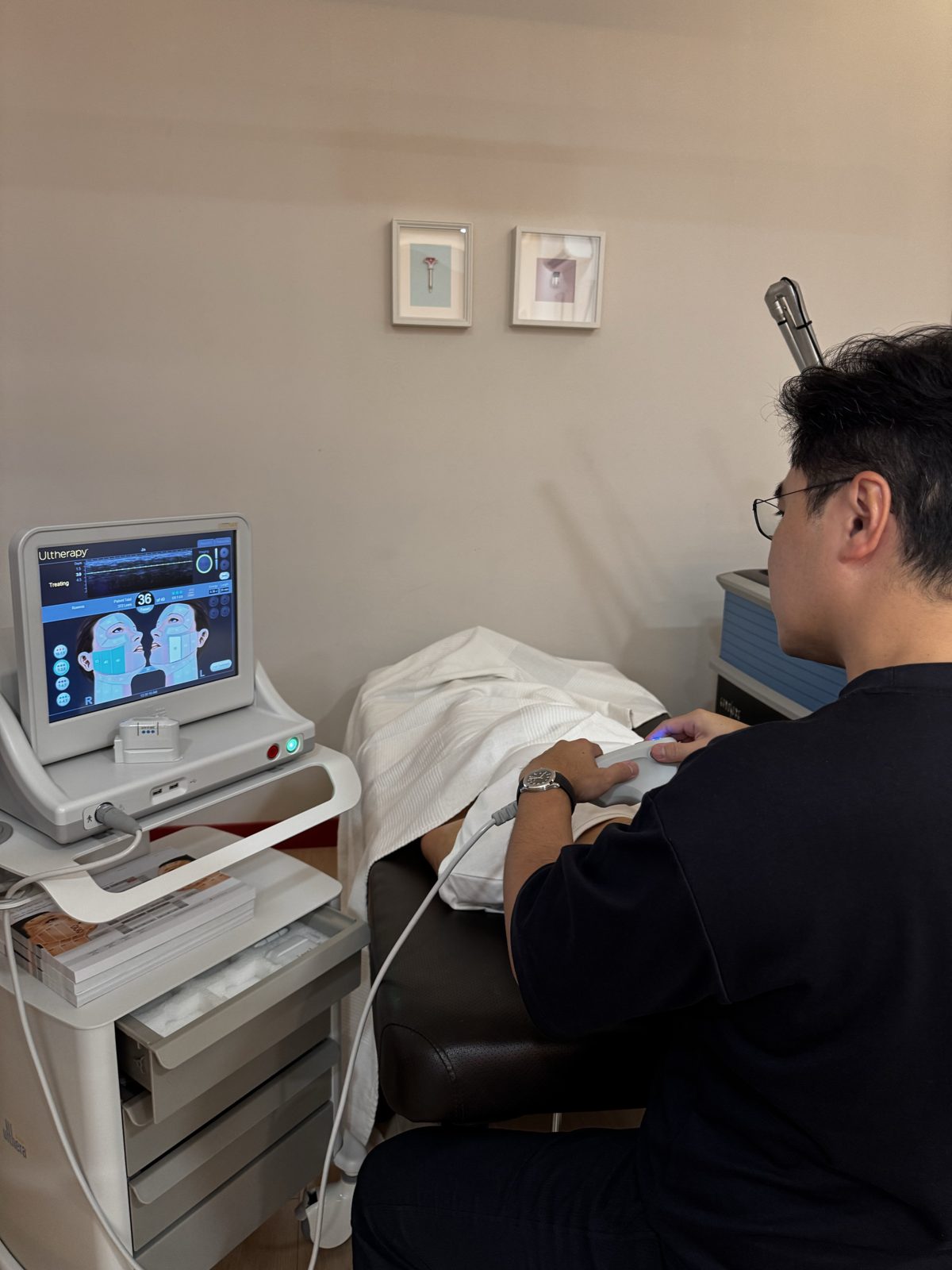
The catch, and it is an important one, is that the response takes time. The collagen remodelling that follows happens over two to three months. The result is not the treatment; it is what the tissue does after the treatment. That is either a reasonable trade-off or it is not, depending on what you are trying to solve and when.
What it lifts, and what it cannot
The honest version of this list is shorter than most marketing suggests. Ultherapy addresses early-to-moderate laxity in the brow, the lower face, under the chin, and the neck. In the right candidate, the improvement is real and visible once the collagen has built.
What it does not do: it does not restore volume. A face that looks tired or hollowed is often losing volume as much as losing structure, and focused ultrasound does not address that. Dermal fillers or biostimulators are the relevant tools there, and the two conversations should not be confused.
It does not match a surgical outcome on advanced laxity. If the degree of skin looseness is significant, the tissue remodelling that ultrasound can achieve is not a proportionate response. Referring someone toward a surgical conversation is sometimes the most useful thing a clinic can do.
And it does not produce an overnight result. If the timeline is the problem, this treatment will not solve it.
Where it sits among the approaches to collagen
There are broadly three ways to ask the skin to build new collagen, and they differ by depth, mechanism, and what kind of change they are best at producing. That framework is worth understanding before choosing any of them.
Focused ultrasound reaches a deeper focal point than most energy-based treatments. Radiofrequency, including XERF and similar modalities, works at a different depth and heats a broader field rather than a precise focal plane. Neither is universally better. They address different things, and for some faces the right answer is a staged approach using both at different points in a treatment plan.
The assessment determines which the face needs. Sometimes neither is the right first step. That is a conclusion worth arriving at honestly, before any treatment is booked.
The candidacy question most marketing skips
The commercial version of the Ultherapy conversation goes: the machine is the best, here is the price, book now. The clinical version starts somewhere else entirely.
Skin thickness matters. Laxity stage matters. There is a window in which focused ultrasound can produce a meaningful collagen response, and outside that window, the treatment underdelivers. Pain tolerance is a real consideration; this is not a comfortable treatment for everyone, and a patient who is not prepared for that will not have a good experience regardless of the outcome.
Timeline expectations may be the most important variable of all. The result arrives months later. A patient who needs a visible change before a specific date is not the right candidate, and saying so directly is part of the assessment.
The people who should be told no: anyone whose primary concern is volume loss rather than laxity; anyone with advanced laxity that exceeds what collagen remodelling can address; anyone expecting a result equivalent to surgery. These are not edge cases. They come up often, and the right answer is a redirect, not a booking.
On cost, since people ask before anything else
The search data is clear: people look up Ultherapy price before they look up anything else about how it works. That is understandable. It is also a slightly backwards way into the decision.
The cost of an Ultherapy session in Malaysia varies because the dose varies. The number of lines delivered, the areas treated, and the depth settings are all calibrated to the individual face. A figure quoted before an assessment is a marketing number, not a clinical one. It tells you what the clinic charges for a session, not what your face needs or whether it needs this at all.
There is a version of this treatment that is genuinely worth the cost for the right candidate. And there is a version where it is the wrong tool, competently delivered, and the cost is entirely wasted. The difference is not the machine. It is the assessment that precedes it.
We discuss cost once we understand what the face actually requires. That is the sequence that protects the patient.
The honest close
Ultherapy is a legitimate treatment with a credible mechanism and a real clinical role. It is not a facelift. It is not a solution for every kind of ageing. It works gradually, it requires patience, it is not comfortable for everyone, and it is not the right answer for a significant proportion of the people who ask about it.
The patients it suits well tend to leave satisfied. The patients who were told it would do something it cannot tend to leave disappointed, regardless of whether the treatment was performed correctly.
The approach here starts from the diagnosis. The consultation is where we work out whether Ultherapy is genuinely the right tool, and if it is not, what is. That conversation is always worth having before the treatment.