
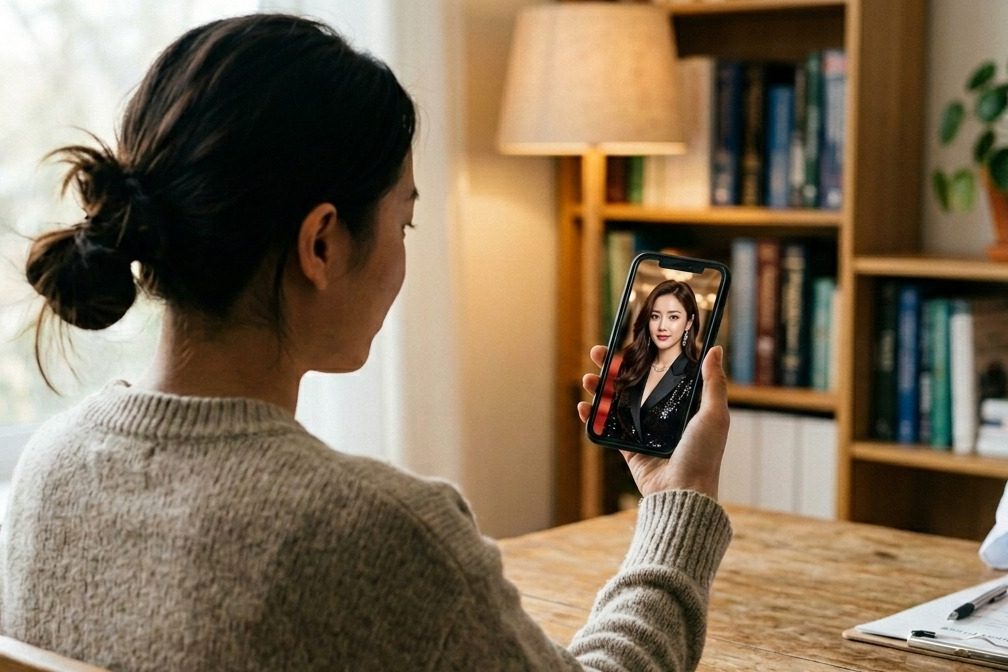
The photograph on the phone
A patient turns her phone toward me and shows me a photograph. Sometimes it is a Korean actress. Sometimes a K-pop idol. Sometimes a Hollywood face that has come back into the algorithm this month. In some version of the sentence, she says, "I want to look like this."
It is one of the most honest questions a patient can ask, because it tells me what she wants before she has the words for what she wants. It almost never ends with the treatment she came in thinking she would book.
The reference is built on different bones
Faces are not made of one ingredient. They are bones first, then fat pads, then muscle, then skin. The way light catches a cheekbone is decided by the bone underneath. The way a smile pulls is decided by the line of the underlying muscle and how the skin sits across it. Each of these is fixed long before anyone walks into a clinic.
There is plenty an aesthetic doctor can do on the surface. You can soften a line that has set in too early. You can restore a small amount of volume where time has hollowed a temple or a cheek. You can lift skin quality, soften pigment, smooth texture. None of this asks the bone underneath to become anyone else's bone.
So the photograph on the phone is a face built on a different scaffolding. Whatever I do to her skin and her soft tissue, the bone keeps producing her face, not the face in the photograph. The light still falls where her light falls. The smile still pulls where her smile pulls. The result is her own face, made a little more rested, a little more in proportion, a little more like a version of herself she recognises. The result is her own face improved. It is not the woman in the photograph, and it was never going to be.
What an experienced eye clocks in two minutes
Most experienced doctors clock the gap in the first two minutes. We are doing nothing clever. We are reading the difference between the reference and the face in the chair, the way a tailor reads a body across the shop floor without lifting a tape.
What I am looking at: the height of the cheekbone, the breadth of the lower face, the angle of the jaw, the projection of the brow, the proportions from temple to chin. These are the things the patient may never have named, but they decide whether her face has the same architectural vocabulary as the reference, or a completely different one.
When the vocabulary matches, a small, well-placed intervention can carry a long way. When the vocabulary does not match, the same intervention produces a face that looks neither like the patient nor like the reference. She leaves the chair quietly disappointed and not quite sure why. This reading is most of what a careful consultation is doing in the first ten minutes, and it happens before any treatment is on the table.
The conversation that has to happen first
The wrong way to handle the photograph is to laugh, or to dismiss it as unrealistic. She knows perfectly well that she is not walking out of the clinic looking like an actress she has saved to her camera roll. What she is showing me is a feeling. Something about that face has caught her, and she is hoping I can name it for her.
So that is the conversation. What is it about this face? The soft definition along the jaw? The lift through the cheek? The brightness of the skin? The expression around the eyes? Once we are talking about a feature instead of a person, the consultation moves from fantasy to anatomy. We can look at her own face honestly, decide which of those qualities she already has, which can be drawn out gently, and which would not sit well with the rest of her features.
Sometimes she leaves wanting one small thing. Sometimes she leaves wanting nothing yet, because what she actually wanted was to be heard about how she sees herself. Either way the consultation has done its work.
A consultation that skips this step, that runs straight from the photograph to the treatment menu, is the one that produces the over-treated faces you can spot from across a room. Each individual injection was defensible on its own. The composite was someone chasing a reference that did not belong to her, and a clinic that took the booking instead of asking the question. The way we think about a face is built to stop that from happening here.
The most expensive treatment is the wrong one. Often it is wrong because the goal was someone else's face to begin with. The cheapest correction is the consultation that gets the goal right in the first place.
There is nothing wrong with bringing the phone. The phone is a useful starting point. It just is not the destination. The destination is your own face, on a well-rested morning, in honest light, looking like a slightly better version of itself. That is the goal aesthetic medicine is genuinely good at. The rest is photography, genetics, or both.