What is the Medical Device (Designated Medical Device) Order 2026?
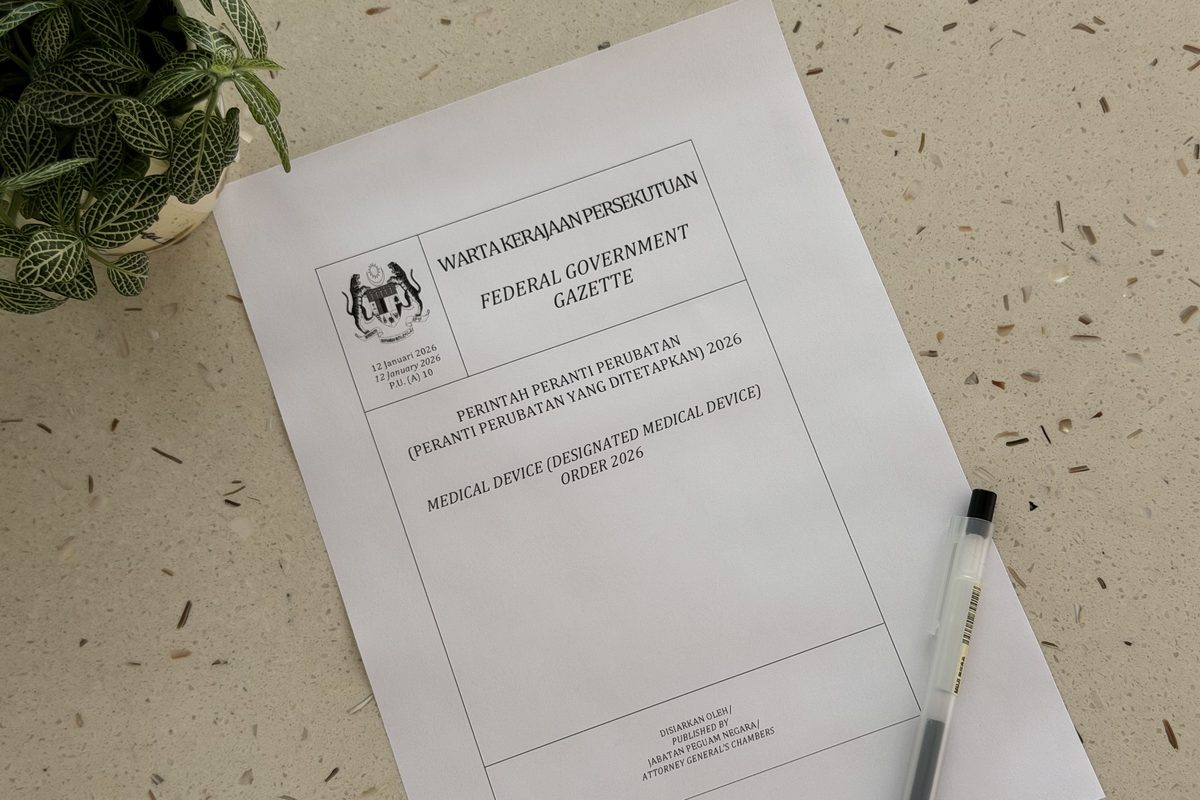
It is subsidiary legislation, numbered P.U.(A) 10, made under section 26 of the Medical Device Act 2012. Section 26 lets the Minister, after weighing a device's risk level and its exposure to the public, declare it a designated medical device by an order published in the Gazette. That is the whole mechanism. No debate in Parliament, no press conference, a notice in the official Gazette and a date on which it begins.
It took effect on 1 June 2026. The Gazette is the legal instrument itself, not a summary of it, and it is published on the Medical Device Authority portal. If you want the primary source rather than anyone's reading of it, including mine, the order is published on the MDA portal.
Which devices are now designated?
The schedule names medical lasers, identified by wavelength, alongside HIFU and liposuction devices. The lasers listed include ruby (694nm), alexandrite (756nm), diode (800nm), Nd:YAG (532nm and 1064nm), erbium:YAG (2940nm), fractional CO2 (10,600nm), and pulsed dye (585nm and 595nm), each tied to the cosmetic purposes it is used for, such as pigment reduction, hair removal, vascular lesions, and skin resurfacing. A note for anyone reading the Gazette alongside this: the Order prints the alexandrite wavelength as 756nm in both its Malay and English text, where the figure conventionally quoted for alexandrite is 755nm. I have kept the Order's figure because the Order is the instrument, and I mention the difference so that a reader who knows the device is not puzzled by it.
The wavelength is not decoration. It is the whole point. A wavelength decides how deep the energy travels and what it is absorbed by, which is to say it decides what the device can treat and what it can damage. Defining these tools by their physics, rather than by the brand on the housing, is the law refusing to be distracted by marketing names. HIFU, high intensity focused ultrasound, is listed for tightening and for fat reduction. Liposuction devices are listed as the physical procedures they are.
Can beauty salons still offer laser or HIFU in Malaysia?
From 1 June 2026, operating any of these devices requires a permit. Section 27 of the Medical Device Act 2012 states that no person shall use or operate a designated medical device unless that person holds a designated medical device permit granted under the Act. The permit framework requires the operator to be qualified and recognised as competent by the authorities.
So the question is no longer whether a premises calls itself a clinic or a salon. It is whether the person switching on the device holds the permit the law now requires. I want to be careful here, because the honest position is narrower than the headline. The Order does not declare that every salon has been breaking the law, and it does not say in plain words that only doctors may operate these devices. What it says is that lawful operation now turns on a permit and on recognised competence. Whether a given operator outside a medical setting can obtain that permit is a matter for the Medical Device Authority's criteria, and that is precisely the thing a patient is now entitled to ask about.
Why were these devices regulated?
Because of what they do to tissue. A medical laser deposits energy that is absorbed below the surface of the skin. HIFU delivers focused ultrasound to a depth you cannot see and cannot feel your way to. Liposuction removes fat through a physical procedure with its own risks. Each carries a real possibility of burns, scarring, pigment change, or deeper injury when the dose, the depth, or the placement is wrong, and several of those effects are not reversible.
This is the part that did not need a new law to be true. The physics has always said these are medical instruments. The law has now caught up with the physics and said so on paper. Regulation here is not bureaucracy for its own sake. It is the recognition that a tool which can injure should be in the hands of someone trained to know when not to use it.
What is not covered?
The Order does not name every aesthetic device. Two common ones sit outside its schedule. Intense pulsed light, IPL, is broadband light rather than a single wavelength laser. Radiofrequency devices heat tissue with electrical energy rather than with light or focused sound. Neither is named in this particular Order.
Outside this Order is not the same as outside the law. Every medical device in Malaysia still requires registration under the same Act. What being outside the schedule means is narrower: IPL and radiofrequency are not, for now, subject to the designated device permit that lasers, HIFU, and liposuction now carry.
It would be reasonable to expect some attention to shift toward the devices that sit outside the schedule. I would not read too much into that, and I would not sneer at it. It is a reminder that the category a device belongs to matters more than the name it is sold under. A radiofrequency device is a genuinely useful tool for the right indication. The right question does not change with the regulation: is this the right tool for my problem, and is it in the right hands.
What should I ask before my next treatment?
One question sits underneath all of this. Is the person treating me permitted and qualified to operate this device. It opens into three.
First, is the device itself registered with the Medical Device Authority. Second, does the operator hold the designated medical device permit the law now requires. Third, and the one a good clinic actually welcomes, who is making the diagnosis, and is the treatment chosen because it fits that diagnosis rather than because it is on the menu. The first two are the new law. The third is the older principle the law is quietly pointing at. It is not the treatment, it is the diagnosis, and a device in capable, permitted hands is still only as good as the judgement that decided to reach for it. That is the kind of clinic this is meant to be.
A closing note
The Order was gazetted, not announced. Quiet lawmaking of this kind favours the informed and leaves everyone else to catch up later, often in the chair, often after the fact. Patients in Selangor and across the country were having these treatments long before most of them had heard the words designated medical device.
I do not think the useful response from a medical clinic is to claim vindication. The job in a moment like this is duller and more worthwhile. Explain what changed, in language a patient can act on, and then step back and let them draw their own conclusion about where they are treated, by whom, and with what. The law has drawn a clearer line. What you do with it is yours to decide.
This article is general information about a regulatory change, not legal advice. For the binding text, read the Gazette.